Sunday, February 13, 2022

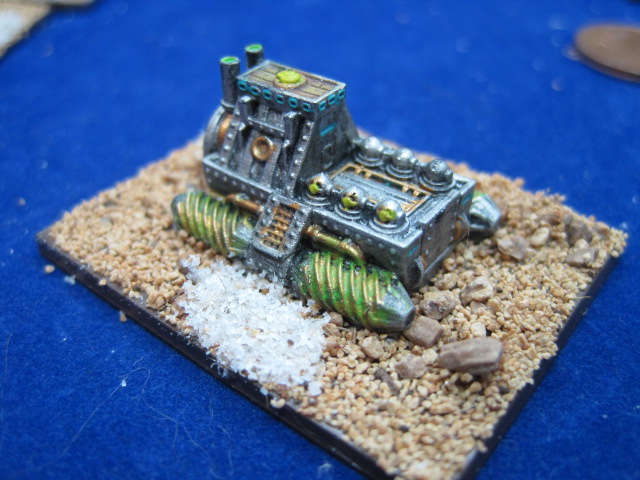
Covenant of Antarctica - Orpheus Drone Controller Tank

For the Covenant of Antarctica/Enlighted faction in Dystopian Wars, I have painted nine Orpheus Drone Controller tanks. They were painted the same as my Xenophon small walkers with the addition of Arcane Blue for the windows. There are no rules for them in the third edition of the game.


In the second edition, they had a turn radius of zero, decent broadsides could launch one SAS fighter each, and could grant excellent abilities for its SAS squadrons. One of these can be attached to any non-small unit.


Saturday, February 12, 2022

Covenant of Antarctica - Janus Infantry Portal Walker

 For the Covenant of Antarctica/Enlighted faction in Dystopian Wars, I have painted three Janus Infantry portal walkers. They were painted the same as my Xenophon small walkers. There are no rules for them in the third edition of the game.


In the second edition, they had a turn radius of zero, no weapons, and are elusive and small targets. One of these can be attached to any armoured unit. They can set up two portals to allow tiny units to move between them, with some risk determined by a die roll.


Saturday, February 5, 2022

Covenant of Antarctica - Colossus Walkers

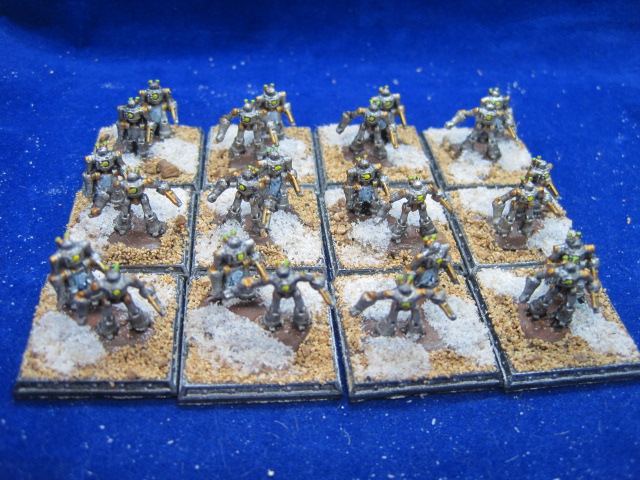
These 12 Colossus walkers are for the Covenant of Antarctica faction, known as the Enlightened in the third edition of the Dystopian Wars game.


They are painted the same as the Xenophon small walkers. They are quite powerful at point blank range but slow. Otherwise similar stats to the Xenophon walker. 


Friday, February 4, 2022

Covenant of Antarctica - Xenophon Small Walker

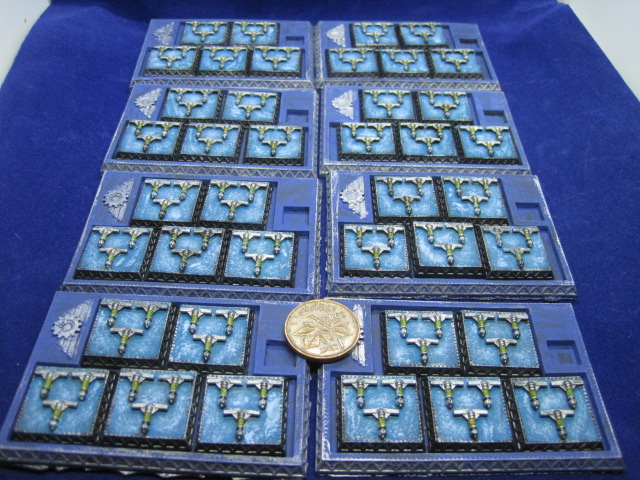
These 44 tiny models are Xenophon small walkers for the Covenant of Antarctica faction of Dystopian Wars, known as the Enlightened in the third edition of the game. 


The models were primed black, rough brush of cheap silver paint. Metal then lightly drybrushed with Privateer Press Radiant Platinum. The bronze parts were painted GW Retributor Armour (I ran out of the PP Rhulic Gold I used for my Naval forces) and entire model washed with GW Nuln Oil. Cygnar Yellow used on the bulbous tops of the walkers and the inside of the engine funnels painted PP Necrotite Green. The base was painted cheap silver around the edge, inside painted cheap dark brown, GW gravel affixed with craft glue, then twice Gal Force snow was applied in clumps. Because the models are so small, I put the flocks on so that clear channels were in frount of the model to the edge of the base. Even though they have a turn radius of zero, it helps to know where they are pointed.


In the older edition of the game, they had great movement, decent forward firing gun, tough, and deployable in squadrons of two to five models. They are also all terrain and hard to hit.


Sunday, January 30, 2022

1989: Dawn of Freedom

 The GMT game 1989: Dawn of Freedom is about the historical events in Eastern Europe when the Soviet Union restricts and stops financial and military support of the satellite countries under its influence. It uses the Twilight Struggle card mechanics. The cards are based on events that took place during 1989 that had an impact on Eastern Europe. The two players are the Democrat player and the Soviet player.


The map is similar to that in Twilight Struggle, in that there are major regions (countries) and sub-regions (geographic areas or groups). 


There are scoring cards but diverging from the Twilight Struggle mechanic is the power struggle. If a player controls one sub-region, they get six cards. They get two additional cards for each additional region they control. If the opponent controls no sub-regions, they lose the power struggle. Players then start alternating playing cards, with the initiative going to the player who played the power struggle card. The player with initiative can play a card with a suit (rally in the square, march, petition, or strike), a wild card, or a leader (but must name a suit). The opponent must play a card matching the suit or a leader card. Players can only play leaders that match a space they have control over in that country (religious space for church leader, elite space for elite leader, etc). If the player with initiative or the opponent cannot play a card, the other player wins the power struggle. The loser rolls a die, applies any modifiers, and must remove the influence listed in that country. The winner then rolls a die, applies any modifiers, and receives victory points based on the number. If the Democrat player won the power struggle and rolled a modified result of four or more, then Soviet control of the country fails and becomes democratic. That country can never again have a power struggle and not be scored again for the rest of the game (card removed from the game). Regardless who won, the country is scored for both players. However, each time the Soviet player wins a power struggle in a country they receive a bonus each time it is scored based on the number of times they won. This is indicated by influence markers beside the country name.


I really liked this game for its historical theme and the familiar Twilight Struggle mechanics.

Saturday, January 29, 2022

Twilight Struggle

 The GMT game of Twilight Struggle is an amazing two player game that has a lot of strategy. Every action matters as it teaches about the history of the world from the end of WW2 to the end of the Cold War in 1989, through focusing on the struggle between the USA and Soviet Union. It also rarely plays similarly the same way twice providing for lots of re-playability. Sometimes I have won or lost within a few turns and a few games have lasted until the late war period. It takes anywhere from an hour to three hours to play. The game will end after the tenth turn is played or when someone reaches 20 victory points. During each turn, starting with the Soviet player, a card is played until seven cards are played by both players upon which the turn marker will advance and more cards dealt out to bring the hand up to eight cards.

Below is the map. Each region, like Europe or the Middle East, is subdivided into different countries that have a number in the upper right. This number is the amount of influence one player must have more than the other player in order to have control over it. If the country name is a dark blue-ish colour, then it is also a battleground country. This is important for when regions are scored and for the required military operations. In the map is also the starting influence in each country for both sides. Each side also gets additional influence that can be placed in Europe, West for the USA player and East for the Soviet player. 


The cards in the game are the most important part, as they will determine how the player conducts operations (realignments, places influence markers, stages coups, conducts space race actions) or important events. The cards are divided into early, mid, and late war categories depending on when they occurred in history. New era cards will only be added once the turn they begin occurs (turn four for mid war and turn eight for late war). The card is either a scoring card or a regular card with a number in the upper left (with a background in red for Soviet or white for USA) and an event action in the main body. When a card is played the player must decide if they are using the points or the event, if it is an event in their colour. They cannot do both their event and use the points. Regardless if the player uses the points if the event is for one of their opponents, then event must occur but the player who played it can decide what happens first. Other events are placed in the discard pile and can be reshuffled and become the new deck. This means that as the game progresses all the events are played, with some being played more than once, thus showing the unfolding of historical events. Some cards say that if the event is used, the card is removed from play. If the event has an * and underlined in red, it will either allow a certain card in the future to be played as an event or requires a card to have been played as an event in the past. 

Some samples of early war cards are below:
-The upper left card is The China card, which the Soviet player starts with. It grants a bonus to the operations value in the upper left of the card if all points are used in Asia. The card when played gets handed to the other player to be used next turn. Whomever holds it at the end of turn 10 gains a victory point. The Soviet player shouldn't mind playing it, as there are normally other cards that the Soviet player does not want to play, like those that have events the Soviet player does not wish to happen yet.
-The upper right card is an example of a Soviet event card that allows another card to be played in the future, the Warsaw Pact Formed. It is a very beneficial card that allows five Soviet influence to be placed in Eastern Europe and all USA influence to be removed from four countries in Eastern Europe. It also allows play of NATO. When playing this, the Soviet player has to decide if using this for operations points or the event. The USA player will choose operations points but the event occurs anyways, but determines what happens first.
-The middle row cards are events for the USA player (Special Relationship) and Soviet player (Cambridge Five). As mentioned if the card has the same player's event, they must choose what they want to do: the event or operations points. If another player's event, the event must still occur but they choose what happens first.
-The bottom two are dual player events, Captured Nazi Scientist or Red Scare/Purge. Each player may use it for the event or the operations points.

Here are the scoring cards for the Early war turns. They must be played if they are in a players hand during the turn they are dealt it. If not, they automatically lose. Both players are able to score points when the card is played and can gain a large amount of points when played at the right time, as each side only needs 20 to win. Presence means the player controls at least one country, Domination means they control more battleground countries than the other and at least one non-battleground country, and Control means a side controls more countries and all of the battleground countries. As can be seen below, control of Europe is an automatic win. 


When a player has influence in a country that is more than the opponent by at least the value in that countries upper right corner, they gain control of it. At that point the token is flipped to indicate a solid colour rather than the white box. This makes it easier to determine for scoring and card play.


The space race option is a good way of using up cards with beneficial events for their opponent. The play of that card must have operations points equal to or more than what is indicated below the event. You can also get victory points based on if you are first or second on a space. The card goes into the discard pile without the event taking place, if it is an opponent's event, so it will be coming back into play at some point. Only one space race attempt may be done each turn, unless otherwise mentioned with a card or a space race ability. You only get the ability under the space race location that you are at.


I purchased the acrylic counters for the game, as I see myself playing this for many years to come. The cardboard ones it comes with are tough but the acrylic ones stand out more. 


There is also a computer version on Steam, where you can play the computer player or a friend. The computer version is quite slick and has recordings of news and historical figures playing as the game progresses. 

Sunday, January 23, 2022

Enlightened/Covenant of Antarctica - Massive Bunker Complex and Towers

The massive bunker complex and towers are solid defenses for the Covenant of Antarctica faction in the Dystopian Wars game. There are no rules for them yet for the Third edition of the game under Warcradle. If there are no rules made for these models, I can still use them for my Horizon Wars, Hardwar, or Gaslands games or really any games where I need a structure like these. They were painted the same as my Kepler light carriers, minus the blue dazzle camouflage. 


The towers had options from left to right of: flak, shield, special faction weapon, communications, and gun. 


Sunday, January 16, 2022

Enlightened/Covenant of Antarctica - Air Units

Here are my finished Dystopian Wars pre-third edition of models, for the Enlightened faction. There is an Epicurus Sky Fortress, two Daedalus Large Fliers, two Hyperbius Control Fliers, five Icarus Medium Fliers, ten Ptolemy Mine Layer Fliers, eight Pytheus Bombers, and forty SRS tokens. I am hoping in 2022 that there will be added rules for these models in the third edition orbat.

For those interested in my naval units, the pre-third edition models are here and my 3rd edition Hunt for the Prometheus models are here.


Saturday, January 15, 2022

Enlightened - SRS Older Edition Tokens

Previous to the third edition of Dystopian Wars, SRS (short range squadron) tokens were small square tokens unlike the circular ones in the new edition. Since I need a great many with my pre-third edition models I thought I would paint up 40 of them, although I have more unpainted just in case. They were painted the same as my Kepler Light Carrier except for no blues nor yellow.


Sunday, January 9, 2022

Enlightened - Pytheus Small Flyer (Bomber)

The Pytheus small flyer is a bomber for the Enlightened faction in Dystopian Wars. It does not have rules for the third edition of the game yet, as this is an older edition model, but I want to paint all my models for this faction. It was painted the same as my Kepler light carrier, without any of the blue or Necrotite Green. As most other bomber models that have been made for the third edition are not on stands but are on ~40mm base (see here for the new fighter SRS tokens), I may just put them on a similarly sized base.


Saturday, January 8, 2022

Enlightened - Ptolemy Mine-Layer Flyer

The Ptolemy is a quick, double mine laying flyer for the Covenant of Antarctica (or Enlightened) faction in Dystopian Wars. The also act as a spotter and can use evasive manoeuvre. They have not come out with the rules for this ship in the third edition of the game. It was painted that same as the Kepler light carrier.


Fleshy Residuum Box

I've started painting Malifaux models again. The Fleshy Residuum was the first box of models painted, after a break, because they were...

Popular Posts