Sunday, April 26, 2015

Rhulic Hammerfall High Shield Wall and UA

The Rhulic Hammerfall High Shield Gun Corps and UA is an impressive unit. They have good armor made excellent when shield walling, can combine fire and with the UA can move shoot and move again or even fire twice.
I used the same paints as my Forgeguard, with a few additions of colored paint on the medals of the officer.


I made little errors here and there but I want to move onto other Rhulic models and the Ogrun.

Friday, April 24, 2015

Dystopian Wars Infantry

Here are the five types of Infantry in Dystopian Wars, a miniature game from Spartan Games. They are Calvary (crossed swords), Artillery (cannon), Auxiliary Infantry (middle), Line Infantry (crossed rifles) and Engineers (crossed tools). They are cheap and slow but excellent for defense. The square holes are for small dice to be put in to show their unit strength.

The come in a pack of ten, with two of each. I bought two packs so that I have enough. They painted quick, easy and should stand out on green or tan felt mats.

Sunday, April 19, 2015

Battle of Proteus Scenery

The Battle of Proteus starter boxes that a friend and I bought had the limited resin crashed ship. There was no assembly and it painted very quickly. I used spray Krylon paint for a base and started drybrushing dark to light dollarstore greys. I accented with dollarstore silver, green and blue. Above is them spread out with Terquai Scouts.
Here it is together.
Also included in the box was the paper verion of the crashed spaceship.
Also in the starter were these buildings. They were a total pain to assemble so I found this video.
It came with overhangs to connect multiple buildings together.
A good product.

Friday, April 17, 2015

Terquai - Aquan Recon Allies for Planetfall

These guys are the Terquai recon helix for Spartan Games' Planetfall line.
I sprayed them with Krylon black and drybrushed them with dark to light oranges with a little silver highlights. There was lots of mixing with dollarstore yellow to make it brighter on the raised elements and pilots position in the little walkers.

The teleport nodes look very cool with the plastic screen.
I got it fairly close to the original paint scheme but they have more reds.

Sunday, April 12, 2015

Tuscany Kickstarter

 
The latest kickstarter I participated in was the Tuscany Kickstarter, an expansion for Viticulture from Stonemaier games. I spent the extra money for the second edition of Viticulture, nice box and the metal money. The first player to or past twenty victory points signals the game end at the end of that turn/year. All players then have till the end of that turn/year to get victory points.
The board is a combination of nice art and practical usage. From a glance you have an idea at what is going on.

It is a worker placement game where you first decide on what turn order you want to go in. Most turn order spots have bonuses.
Then begin to place your workers in the summer phase (left half of the board) Once everyone has passed placing units, each player gets either a summer or winter visitor card. Then you start placing workers in turn order until all have been placed. Once the winter phase is done, residual payments for orders filled are given (max five), cards in hand discarded down to seven, first player is rotated counter-clockwise and...
Grapes in the crush pad and cellars are aged. This is one of the important features of the game as you need better quality wines to fill orders worth more victory points. You can also improve your vineyard, including cellar quality, using your personal pad. When you start you get two regular workers, one large worker, two lira, a pinot vine card and a random summer visitor card.
Below are the different vines you can plant. Each field can have no more than six points worth of grapes and many vines need either a trellis or water tower building established before planting.
The victory points continue beyond twenty in case players get more. Money is used as a tie breaker.
Here is an assortment of wine orders. They include reds, whites, blushes and sparkling wine. The purple number is the victory points gained and the orange number is the residual payment.
A note on the workers. The large worker can still be placed on spaces that are filled so that way you are not shut out of an action. You can also hire more workers during the game.
Here is how the whole wine making process works. Say you have already planted three kinds of vines.

Then you take the crush action. You would get a three value grape and a three value white. That is indicated on your crush pad with a clear stone. Each year, if let alone, the grapes would increase in quality by one until a maximum value of nine is reached.
If you take the make wine action, you put the marker for the grapes in the crush pad and put it in the cellar.
You are stuck at a maximum value of three for your wine and it won't age each year until you build a medium cellar. If that occurred, then at the end of a turn/year the three value wines would become a four. It also allows for red and white grape token in the crush to be combined for a blush.
A large cellar would allow for wines up to nine. It also allows for two reds and a white grape token to be combined to make a champagne.
The money the second edition of Viticulture comes with is perfectly fine but the metal money looks and feels better. Can't be stacked though.
Also in the Tuscany expansion is lots of small expansions. Its meant to be like Risk: Legacy where new expansions are opened and incorporated by the winner after each game. The slots for them are great.
Sample expansions are the fruit and cheese expansions.
I've played this game three times now and really like it. Each player can play their own game that is in conflict with others only because others are competing to do the same activities.

Friday, April 10, 2015

Little Fears RPG

Little Fears is an RPG I picked up last year at a used book store. It is a masterfully made RPG set in the world of children in which their fears, and hopes, can come true. Imagine that. The scraping branch on your window. The creepy neighbour. The monster under the bed.
The system uses a point system to make your character. Innocence is set on the age of the child. You then can choose advantages and disadvantages to round out your character and choose more advantages the more disadvantages you pick.
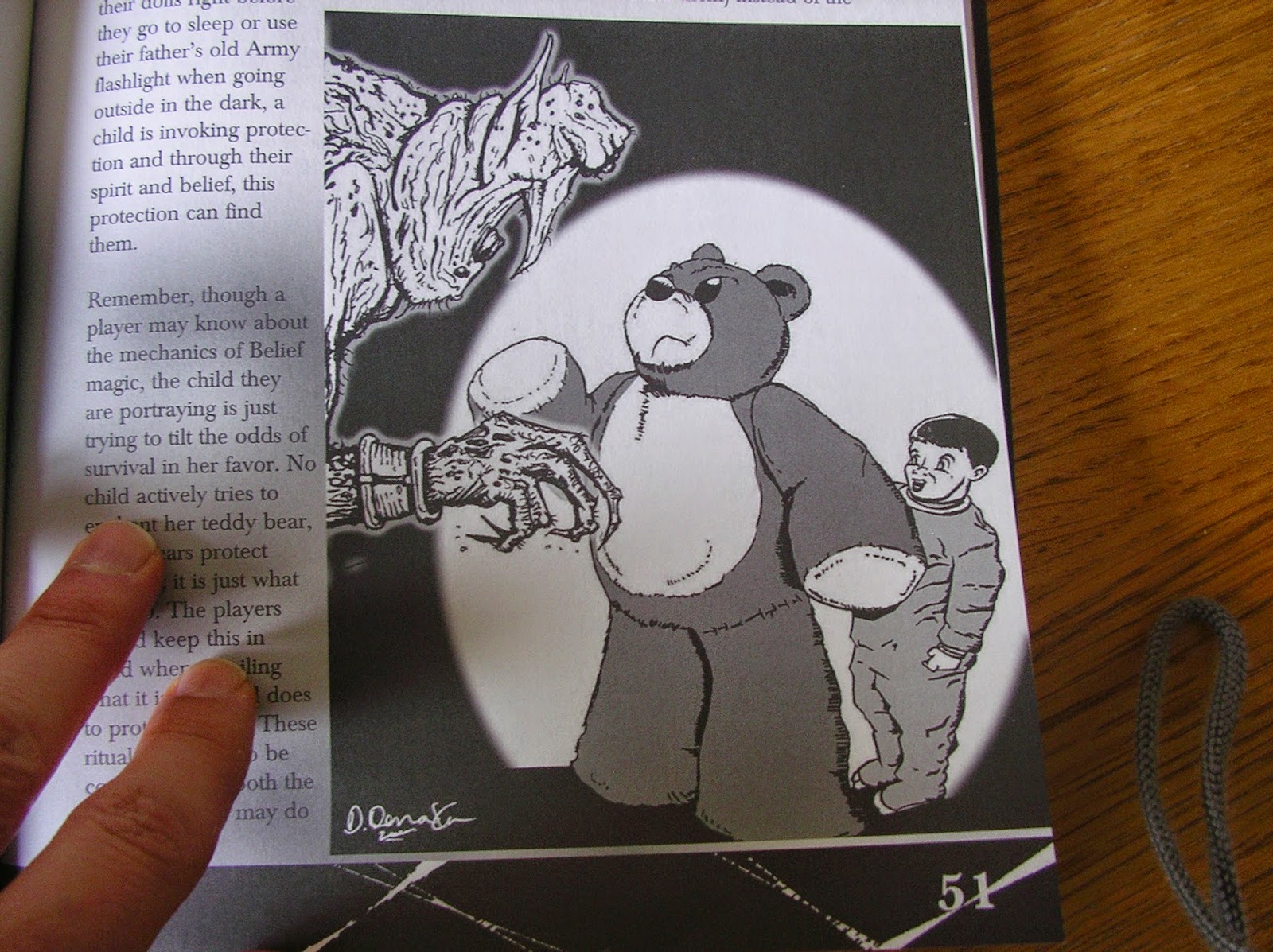
Your hopes and beliefs can give you power against the monsters in the world, such as a teddy bear illustrated above.
The most monsters are organized and come from a realm called Closetland. There are seven kings who are based on the seven deadly sins and are ruled by the Demagogue. Each kings realm is attuned to them.
Above all the game is about dealing with the imagined and real fears, superstitions and dreams we all had when we were young and have lost as we get older. There is an appropriately heavy undercurrent of real evil that the players can become involved against; the corruption of children, especially by adults. The game also specifically states that it is important to set the level of maturity, while playing children, that the players are comfortable in dealing with.

Although I have not played this game yet, I am interested in doing so as it looks like a great storytelling experience.

This edition I read was the first one. There is a newer Nightmare edition available from the website at the beginning of this post.

Sunday, March 29, 2015

1775

1775 is an excellent low complexity wargame that is still full of strategy and history. The object of the game is to have control of more colonies than your opponent. There are a few scenarios for playing a shorter or different historical battle (Battle for Quebec).
The board is well illustrated. Green cubes are First Nations (neutral until friendly units are moved on top of them), American Colonists (Blue regulars and white militia), and British Forces (Red regulars and Yellow Loyalists). Setup is indicated by the cube illustrations in each region. Here is the board after the American setup.
After the British setup.
In combat, you roll one die for each cube of the color you have, to a maximum of three for irregular and two for regular troops. Defender rolls thier dice and applies the result first. Targets are hits, running men are flee results and blank die are command decision (may move the corresponding colored cube to an adjecent friendly region. Dice are rolled until one side has lost off of its cubes.
Turn order is done by randomly drawing a cube from the black bag. You must play one move card and as many event cards as you wish. The game can end sooner if the forces on one or both sides have played all of thier "Treaty of Paris" cards. Move cards indicate the number of armies that can move (some or all the cubes in a region) and how many spaces they can move. There is also ship and boat movement in the game.
Renforcments are placed during the beginning of your turn. Four cubes plus all of your fled units can be placed on any region your side controls that has a city, like Halifax above.
Here is the game after a few turns. There are French and Hessian allies that can join the fight through playing of cards.

I love the simple elegance of this game.

Friday, March 27, 2015

A Few Acres of Snow

A Few Acres of Snow is a historical boardgame from Treefrog Games.It is based on the French and Indian war of 1754-1763. It has a mechanic similar to the game Dominion where cards are selected/purchased and placed in the discard pile to be later shuffled to form the draw pile when it is exhausted.
Above is the game board set up. There are two ways of winning: collecting enough villages cubes and/or town disks through successful sieges and raids, or the British laying successful siege on Quebec or France laying a successful siege on Boston or New York.

The gameplay goes slow, with up to two actions per turn plus a free action, but each activity matters in the overall game. It lends itself to the feeling that large events are transpiring, planned from far away.

The cards themselves have a lot going on but are simple once you know what to look for. At the top you have the location. You get new location cards when you colonize to them or take them over. They are also important for setting up fortresses and expanding from a village to a town.

The next area has a list of places the colony is connected to and how to get there. At the bottom is a list of what else the card can be used for: ship, military, settlers or money. For instance, to settle Halifax, you could play this card (because it is connected to that place) and would then have to play a card with a ship (to get the colonists there). If the place to colonize has a settler icon then another card with a settler must be played.

During a siege, this card can be played for another point in the favour of the British.

For funds, this card can be played for three coins.

I have played this game a few times and it is enjoyable and exciting.

Wednesday, March 25, 2015

Battle for Proteus Prime - Objectives

The objectives are the same style as the recent ones made for Dystopian Wars and Firestorm Armada.

I just primed black and drybrushed silver, in order to keep them distinctive on the table top and non-factionalized.

Battletech Models: Jade Falcons

In last week’s post I talked about the Battletech Aces: Scouring Sands campaign box . In it, the antagonist are Clan Jade Falcon remnants an...

Popular Posts