Sunday, May 29, 2022

IMEX - Southwestern Alamo Accessories

I bought this kit a while ago and painted these IMEX Southwestern Alamo accessories. They were painted with cheap paints with some Privateer Press paints for highlights. At 1/72 scale, some items are smaller than than they should for tabletop miniatures but good enough to get a setting across. These kits are also quite inexpensive, especially as it comes with much more than pictured here, as seen on Plastic Soldier Review


Some of the larger cacti I am going to base on 30-50mm bases, once painted, so they can stand up better and the smaller ones are great for bases as seen below and at the link here.


Saturday, May 28, 2022

Fuel Tank

This fuel tank was found in the discount bin of a games store during my travels a few years ago. Painted it up with cheap paints and a bit of Valejo mecha rust on the pipes and metal access hatches on the roof. Good for any 6-40mm scale minis. 


Pictured with it are my 10mm Mechwarrior figs for the Horizon Wars/Hardwar game as well as the 35.7mm or 1/47 scale  Star Wars Legion figs.


Sunday, May 22, 2022

Modern/Sci-fi Obstructions

 Found these in the discount area of a game store. These modern or sci-fi obstructions were painted with dollar store paints and a bit of Mecha rust from Vallejo.


Saturday, May 21, 2022

Barricades and Gates from Plastic Shelving

 Made from spare bits for plastic shelving that I didn't need, come these gates and barricades/walls. They were primed black and painted with various cheap greys. They would be good for all scales but especially for 25-35mm.


Sunday, May 15, 2022

Bot War - First Game

I played my first game of Bot War on Thursday at Everything Games. It was a 60 point game with three of my Beastlords (Brontous, Arkynor, and Parasolar) vs original starter box Valiants (General Duke, Aegis, Wolf, Angel, and Topstar). The scenario was "protect the cargo" and the Valants won the roll, with my honoured opponent choosing General Duke to carry it to my side of the table.


As promised by the game designer, the game is fast and easy to play with good strategy for deciding what to do. The Bot War cardstock scenery looks great on the table with my N scale cars and trucks. 

It was a fun game. Mistakes I made were not using my model's special abilities sooner so I could engage in melee quicker. Also having Brontous leave cover meant he was shot up sooner and couldn't use his earthquake ability more to take out the Valiants smaller models.

Next game I should have some tokens made for interactable scenery so they can be used as one shot shields, clubs, and such. I also need to make damage tokens. Making a card sized paper guide to each model's special rules will also come in handy. Looking forward to my next game in three weeks.

Saturday, May 14, 2022

Marvel Multiverse RPG - Playtest Rules

I picked up the Marvel Multiverse Roleplaying Game playtest rulebook, as I like to keep an eye out for good superhero roleplaying games. This prelude has basic rules including d616 dice rolling system, actions, combat, making heroes, and a very short adventure. The full rulebook will be coming out in 2023.


The d616 is based on the fact that in the Marvel comics, Earth 616 is the regular Marvel comics universe. To make an ability check you roll three d6, one of which is a different colour than the other two (considered the Marvel die). The result of this die roll is the numbers on all three dice added to your total action modifier for the statistic you are using. A 1 on the Marvel die counts as a 6. If the result matches or beats the target number you succeed. 

However, if you succeeded and the Marvel rolls a 1 and the other two are not 1's, you have made a fantastic result which is a "yes" success and something else beneficial, like an edge. If all three are 1's then it is a botched roll, which is a "no" and something bad happens. If the Marvel die is a 1 and the other two are 6's, then it is an ultimate fantastic result is achieved, which ignores any trouble. An edge means that you can reroll a die. Trouble means that the Narrator choses a die for you to reroll.

Edges and troubles can be given before the dice are rolled depending on your advantages and disadvantages at the moment. The greater of one of them cancels the others until you have a net number of edges or troubles.


The character making system is straightforward and variable. You, other players, and narrator decide on a maximum rank for the game with 1 being a new rookie, 5 would be a hero of a neighborhood, 10 a hero of a city, 15 a hero of a country, 20 a hero of the world, and 25 a hero of the universe. They recommend starting 5 ranks below what the narrator is looking at for a longer campaign. 

Then you come up with a concept for you to build your hero. This will guide you when making decisions. 

You then determine your archetype: they are blaster, bruiser, genius, polymath, protector, and striker. The archetype you choose determines ability score caps, action modifiers, defenses, fight and ranged damage, health, and focus.

Then you allocate your points for statistics, which are Might, Agility, Resilience, Vigilance, Ego, and Logic which amazingly spells MARVEL. Your cap on statistics is -4 to 4, the highest human limit but that limit will change with your archetype, traits, and powers. I recommend doing this last.

Now it is time to choose a backstory which is made up of your origin, profession, and additional traits. Origin can be alien, god, high tech, magic, mutant, special training, or weird science and these give you traits.  Professions are what you do when not a hero and gives you extra traits. You then pick additional traits, depending on your rank. Traits are extra abilities or skills that can help or challenge you. If you pick a challenging trait, like Abrasive where you get trouble when making friendly Ego (persuasion) checks, if the player purposely puts themselves in situations where it comes up you get a karma point from the narrator. Karma gives you edges when you spend them but go away when you finish a game session.

Finally you choose your powers from power trees and/or utility powers. The higher your rank the more powers you choose and the greater number from power trees you can pick from. Most powers have prerequisites and some require a minimum rank level to get. The mixing and matching is fun.

Housekeeping is next where you determine your other final scores, like health (damage you can take), focus (mental fortitude), Karma (which gives you edges and is half your rank rounded up), Initiative, speed, fight damage, ranged damage, and size. These are determined by your statistics, traits, and powers.


I made a character using this system with a concept of a Captain Scarlet kind of hero. Captain Scarlet is a character altered by alien entities called the Mysterions to be invulnerable via a "retrometobolization" process and mind controlled to do its bidding on Earth to harm the human race in retaliation for being attacked on Mars. In the computer animated version, the main character was freed from the mind control after being zapped by a special energy source but retained his invulnerability. 

To Marvelize it, I decided he was changed by an entity Hydra obtained to be invulnerable and used as an agent until he was zapped by an SHIELD power source on a helicarrier when trying to sabotage it in flight. Rank level will be 5.

For archetype I choose polymath and choose resistance and vigilance cap to be increased to six. Origin is weird science, which gives me the weird trait (edge for ego checks for those that like me and trouble for those that do not, perhaps because of the process of retrometobolization).  Profession is solder which gives me the traits battle ready, connections: military, and situational awareness. I then decided that he was a low level SHIELD agent which is why he was captured by HYDRA and transformed to be their sleeper agent. For additional traits I choose Fearless, because it was reduced due to the transformation, and combat expert, which gives an edge when in combat with rank 5 or less enemies.

At rank 5 I get five powers from up to two trees. From the Cybernetics tree I choose armour 1 and reinforced skeleton, which gives him overall damage reduction and additional damage reduction vs bashing. For utility powers I choose environmental protection, healing factor, and sturdy. These all give the basics for being really tough in battle, in particular hand to hand. I can see him diving in frount of teammates and taking hits so they can do what they do best.

For stats I get 18 points, which I allocate as follows: Might:2 Agility:2 Resistance:6 Vigilence:4 Ego:2 Logic:2.

Once he goes up in ranks, he can pick up more armour, increase resilience with traits, martial artist powers, and pick up some firearms powers to take the fight to the enemy better.

I am looking forward to the full rulebook and maybe playing some games.

Sunday, May 8, 2022

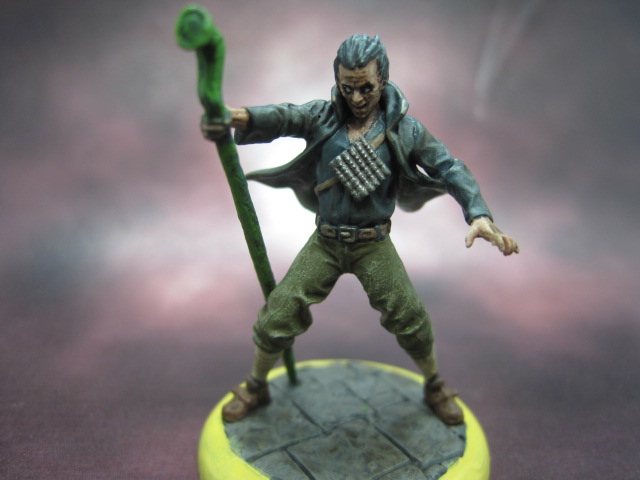
Hamelin

Hamelin can be found in his core box. He gives and manipulates blight tokens for a plethora of effects. He can also lure and control rats.


Primed black. Shirts rough painted Greycoat Grey, drybrushed Cryx Bane Base, lightly drybrushed Cryx Bane Highlight, and lighter drybrush Trollblood Base. Pants painted Traitor Green and drybrushed Thrall Flesh. Skin painted Khardic Flesh, drybrushed Midlund Flesh, and lightly drybrushed Ryn Flesh. Pipes painted Pig Iron and drybrushed Radient Platinum. Leathers painted Umbral Umber and drybrushed Bloodstone. Hair painted Thamar Black and drybrushed Coal Black then lightly drybrushed mix Coal Black and Menoth White Highlight. Thamar Black applied around the eyes with Menoth White Highlight used for the haunted and glowing eyes. Staff painted Coal Black, drybrushed Menoth White Highlight, and washed with Thraka Green with Necrotite Green light drybrushing.


For the base I used greenstuff and a Sanctuary Basius Max plate. Painted cheap black, drybrushed Cryx Bane Base, lightly drybrushed Cryx Bane Highlight, and lighter drybrush Trollblood Base. Entire model and base washed with GQ Agrax Earthshade and rim painted Moldy Ochre.

Saturday, May 7, 2022

Nix

In the Hamelin core box is Nix. A henchman, Nix gives blight tokens to those that start activating nearby, is incorporeal, reduces severity of damage to those friendly models nearby, and utilizes and manipulates blight tokens.

Primed black. Skin painted Traitor Green, drybrush Thrall Flesh and lightly drybrushed mix of Thrall Flesh and Menoth White Highlight. Exposed and worn parts painted Khardic Flesh, drybrushed Midlund Flesh,a dn lightly drybrushed Ryn Flesh. Collar painted Pig Iron and drybrushed Cold Steel. Menoth White Highlight was lightly drybrushed on the exposed bone. Khador Red Base applied to the edges of the exposed flesh and mouth. Thamar Black applied around the eyes with Menoth White Highlight used for the haunted and glowing eyes. Ordic Olive used on the exposed spikey bits arounf the haunches. Rat painted with various greys and Carnal Pink.


For the base I used greenstuff and a Sanctuary Basius Max plate. Painted cheap black, drybrushed Cryx Bane Base, lightly drybrushed Cryx Bane Highlight, and lighter drybrush Trollblood Base. Entire model and base washed with GQ Agrax Earthshade and rim painted Moldy Ochre.

Friday, May 6, 2022

The Stolen

 The Stolen are totems for Hamelin in his core box. They are harder to attack accurately and cannot target it when more than six inches away, give blight tokens to enemy models that start their activation nearby, summon a rat when killed, can damage by vomit those nearby and is more accurate if they have enough blight tokens, and can make models fast and is more effective with rats. A great totem for Hamelin to have.


Primed black. Shirts rough painted Greycoat Grey, drybrushed Cryx Bane Base, lightly drybrushed Cryx Bane Highlight, and lighter drybrush Trollblood Base. Pants and dress painted Traitor Green and drybrushed Thrall Flesh. Skin painted Thrall Flesh and drybrushed mix of Thrall Flesh and Menoth White Highlight. Dagger painted Pig Iron and drybrushed Cold Steel. Leathers painted Umbral Umber and drybrushed Bloodstone. Hair painted Thamar Black and drybrushed Coal Black then lightly drybrushed mix Coal Black and Menoth White Highlight. Thamar Black applied around the eyes with Menoth White Highlight used for the haunted and glowing eyes.  Dress had patch on knee painted same as shirts and stiched painted with Rucksack Tan. Rat painted with various greys and blood on rat and mouth painted with Khador Red Base.

For the base I used greenstuff and a Sanctuary Basius Max plate. Painted cheap black, drybrushed Cryx Bane Base, lightly drybrushed Cryx Bane Highlight, and lighter drybrush Trollblood Base. Entire model and base washed with GQ Agrax Earthshade and rim painted Moldy Ochre.


Sunday, May 1, 2022

This War of Mine

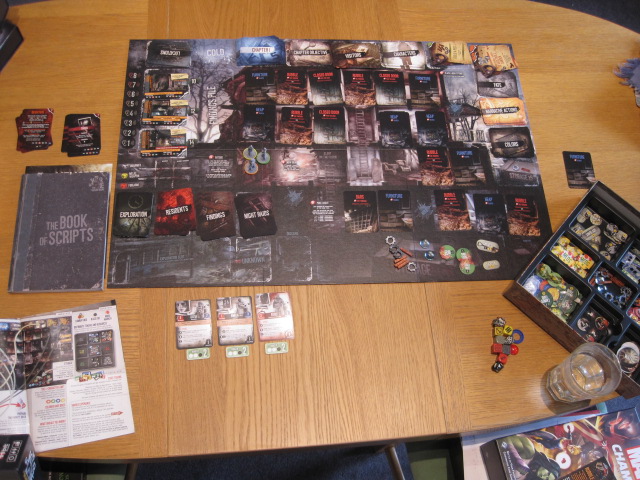
This War of Mine is a board game unlike any other. Although it has war in the title, this game is about civilians caught in the middle of a conflict just trying to survive in a damaged home and city. Because of the subject matter and decisions that are asked to be made, it is not recommended from young children. There are emotional parts and tragic parts. So why am I taking the time to write this favorable review? It is because it is an important anti-war game.


The creators of this game grew up in Sarajevo siege and spend time to gather stories of civilians during that and other modern conflicts. They then created the video game of the same name. The elements of that game were ported over to this game, which I participated in as a Kickstarter. I did that because of the stories told of others who also lived through those type of situations having cathartic moments they lived through and are able to work out those hidden scars. 


The game is a storytelling puzzle game where there are three characters all the players control. Ultimate control of the characters pass from player to player during the phases representing a day in the lives of the characters. The decisions made by the players will hopefully be the right ones to provide enough food, water, rest, and protection characters and the house. Things can be made, with the right components. The house can be cleared to put those things being made. At night, you have to have characters be on guard to protect what you have and determine if you need to send your people out for needed supplies because during the day soldiers are shooting at whatever moves in the streets.


When decisions are made, there is either a mechanism to determine the results or you have to look up a passage in the book of scripts. This is where the narrative comes from and the stories from those who have lived it. 


You "win" the game by making it to the end of the siege with at least one of the original characters and with a low level of misery. You lose by having anything else happen. It is not a game to be played too often but something that should be played often enough, as a reminder of what people go through when civilians are caught in the middle of a conflict.


I went all in for the Kickstarter and was glad I did. The components are nicely done.


You can download a companion app from the board game makers here. The computer game is available here


Saturday, April 30, 2022

Marvel Champions - Core Box

Marvel Champions is a cooperative game for one to four players. I have tried this out a couple of times at a friends place and quite liked it. After I picked it up, I realized how much fun and challenging it is solo.


I will discuss the good guys the players can use. First the game comes with five heroes: Captain Marvel, Spider-Man, Iron Man, She-Hulk, and Black Panther. They all play differently with unique strengths and styles. There are also four to go with the hero decks: Aggression, Justice, Leadership, and Protection. Finally there are the basic cards that are not associated with a hero or an aspect. When making a player deck you can combine cards with a hero (all their cards), cards from one aspect, and basic cards as long as the deck is 40 to 50 cards in size. Can have no more than one unique and three non-unique cards in the deck.

The game also comes with three villains/encounters to face against your hero or heroes: Rhino, Klaw, and Ultron. There are five different modular encounter decks to use with them: Bomb Scare, Masters of Evil, Under Assault, Legions of Hydra, and Doomsday Chair.  There are also a basic mode or expert mode deck of cards. A villain deck must have all of a villain's cards, one encounter deck, and the basic or expert cards. You can add multiple modular encounters to an encounter deck but it will dilute the original encounter. It also recommends randomizing the modular encounter and shuffling it in so nobody knows what it will be.


What also attached me to the game was the math of options. Using the core box playing solo you have five heroes, each of which has a choice of four aspects, against three encounters/villains playable in basic or expert mode, and five modular encounters. That means there are 600 configurations with the starter box alone. That is 600 unique games and when it is a random shuffle to start players and encounters/villains if multiplies the options even more. When playing two, three, or four players games it means that a starter box will keep a group active for a while. When you add the expansion products made so far, the number of possibilities is nearly endless: 22 hero packs (two of which have modular encounters), four scenario packs (with five encounters/villains, 15 modular encounters, and different basic and expert mode decks), and four campaign expansions (with eight heroes, 20 encounters/villains, and 27 modular encounters). Each hero pack also comes with extra aspect cards, beyond those they come with, for customizing other heroes. That makes 35 heroes, four aspects with lots of options and specific hero flavoured ones, 28 encounters/villains, 44 modular encounters, and two basic and expert mode decks. In solo mode alone that is at least 689920 different combinations. But let's get back to the core box.

Even with sleeved up cards, everything can fit. That included the encounter/villain damage dial, threat markers, utility markers, damage markers, stun/tough/confused cards, first player token, player aid cards, and four hero damage dials


Here I am setting up for the first solo game, Spider-Man with Justice aspect vs Rhino with basic mode and Bomb Scare modular encounter. Each hero also comes with a specific obligation card (that goes into the villain deck, and specific nemesis deck that comes in once the basic mode card "Shadow of the Past" is revealed. 


Hero card come with two sides, the Hero side with THW (Thrart), ATK (Attack), and DEF (Defence) with other abilities on the card, and the...


...Alter-Ego side with REC (Recovery) and abilities. Each player turn you can flip your hero card once during the turn. Each side also has a hand limit that you draw up or discard down to at the end of the player turn.


Hero decks are made up of Ally, Event, Upgrade, and Support cards. Cost of the cards to play from your hand are in the upper left corner. To do that you have to discard cards to make that cost using the symbols on the lower left corner. Type of resource can be important depending on the card you are playing. Resources are Energy (yellow lightning bolt), Strength (red fist), Mind (purple atom like), and Wild which can be any of the previously mentioned three (green impact).

Allies are like minor heroes. They have hit points, thwart, attack, and special abilities. For thwart and attack, the number of stars beneath them indicate damage they take when using it. In Black Cat's case, she takes one damage when thwarting but none when attacking. That means this ally can help take out minions and villains all day long. If they do take points to be removed from play, the number in the middle right, they retreat to the discard pile and can come back again after a rest and reshuffle.


Aspect cards have the same four types of cards with one additional type, the Resource card. They provide more than one resource to use when buying cards or a special allocation of a resource.


This is similar to the Basic cards.


Here is a closeup of Spider-Man's Nemesis cards: The Vulture's cards and Eviction Notice. When the basic mode card ""Shadows of the Past" comes out, the hero's nemesis is put into play engaged with them, the special nemesis side scheme is put into play, and the other nemesis cards are shuffled into the Encounter/Villain deck. Eviction notice, as well as any hero's obligation card, is shuffled into the encounter/villain deck at the beginning of the game.


Here is the start of play and because I am playing basic mode Rhino his level one card is on top (in expert it would be level two), Rhino's main scheme is in play, and I have my hand of six cards after I have taken my mulligan, meaning after I deal my initial hand I can toss any number of those cards into my discard and draw back up to my hand size. 


Play then proceeds as follows. The first player (in solo games it is the only player) takes their turn under step one in the picture below. They mainly use guards to improve thier hero, reduce hit point or remove threats on schemes, help their fellow heroes, and bring out allies and resources. Once all players have finished all players perform step two. Then the villain places threat on the main scheme. For Rhino, the main scheme starts with no threat on it and it increases by one per player at this step. This number can be modified by side schemes. Then Rhino and each minion, in player order, either attacks if the player is in hero form or schemes if in alter-ego form. Normally when a villain attacks or schemes you flip a card from the top of the encounter/villain deck to add to the number listed on the card to determine how much damage the hero takes or how many threat is placed on the main scheme. Heroes can decide to have an ally take the damage before the card is flipped or exhaust the hero to defend and reduce damage taken according to the hero's defend stat. Otherwise the hero takes damage. Minions do not flip a card to increase scheme or attack, just use the printed number on the card.

Then encounter cards are dealt out to the heroes face down and are resolved order with first player going first. After everyone's encounter cards are resolved, the first player token is moved clockwise and it is now the player's turn. Once a level of encounter/villain has been reduced to zero hit points or less, the next level of villain is revealed. In all games there is only two levels of villain but be aware to read the card when going to a new encounter/villain.

Once Rhino's main scheme reaches seven times the number of players, at any time, then Rhino wins. Some villains have more than one schemes that have to be achieved in sequence. Ultron, for instance, has three.


In my first game against Rhino I won with Black Cat as an active ally, web shooters with two more uses left, Avengers Mansion, Helicarrier, and Aunt May on the table. 


Rhino at the end of the game had no side schemes or minions but did have four threat markers on his main scheme. Rhino isn't supposed to be a tough villain but a good learner villain. 


So far with the core box I have played 44 games, broken down as below:

-Spider Man Justice vs Rhino (Bomb Scare 2, Masters of Evil, Under Attack, Doomsday Chair, Legions of Hydra), Klaw with Masters of Evil 2, Ultron with Under Attack 2. All wins.
-Captain Marvel Aggression vs Rhino Bomb Scare 2, Klaw with Masters of Evil 3 failed. I then changed the aspect to Leadership and vs Klaw Masters of Evil success and Ultron Under Attack 2 successes. Solo play was not conducive to use Aggression. 
-Black Panther Protection vs Rhino with Bomb Scare 2, Klaw with Masters of Evil 2. I switched up with Leadership against Ultron with Under Attack and got two wins.
-She Hulk Aggression vs Rhino with Bomb Scare 2 but against Klaw it was three losses. I switched to Protection and got two wins and against Ultron with Under Attack it was two wins. Again solo Aggression is very tough.
-Iron Man Aggression vs Rhino with Bomb Scare 2 wins but won and lost once against Klaw with Masters of Evil and three times lost against Ultron with Under Attack. Switched to Leadership and won two and lost one against Klaw and won one against Ultron. Recommendation based on my previous games is not to take the Aggression aspect in solo games...ever.

In a nutshell I really love the solo option for this game. Looking forward to more games with others and solo. I will also be trying out the other heroes, scenario packs, and campaign boxes and reviewing them here.

There are some free encounter/villain options out there:
-Story mode for the Core box: https://boardgamegeek.com/filepage/235820/marvel-champions-story-mode-s1-v10

There are also many other alternate fan made items: DC Comics Characters, DC and Marvel Characters, dividers, Hall of Heroes, and much more online at Board Game Geek or Reddit/MarvelChampionsLCG. Some really cool storage solutions, like these too. I especially like the reusing of cassette tapes for hero decks.

Batman...and Friends

"Bruce," Nightwing said while smiling, "you came. Thank you." With a deep gravel-filled voice Batman said, "It seem...

Popular Posts